A working fire alarm system is the single most important piece of safety equipment in your home. According to the National Fire Protection Association, three out of five home fire deaths happen in properties without working smoke alarms. Yet most homeowners treat fire alarms like set-it-and-forget-it devices, until the low-battery chirp starts at 2 a.m. Regular maintenance isn’t complicated or time-consuming, but it directly affects whether your system will function when seconds count. This guide walks through the monthly and annual tasks that keep detectors responsive, explains how to troubleshoot common issues, and clarifies when professional service is worth the call.
Table of Contents
ToggleKey Takeaways
- Fire alarm system maintenance requires just 15 minutes monthly and an hour annually, making it an essential investment that directly impacts whether your detectors function when seconds count in a fire emergency.
- Test your smoke detectors monthly by pressing the test button for 3–5 seconds and replace all batteries yearly; smoke alarms have a 10-year lifespan and must be replaced regardless of apparent function.
- Relocate detectors prone to false alarms at least 10 feet from cooking appliances or bathrooms, or switch to photoelectric models, rather than disabling units that compromise your home’s safety.
- For hardwired systems, verify the green LED indicator is lit to confirm AC power, and inspect wire connections for corrosion; if interconnected alarms won’t sync, check that interconnect wires are firmly attached.
- Hire a licensed electrician or fire alarm technician for hardwired system installations, monitored security panel integration, or recurring issues that persist after cleaning and basic troubleshooting.
- Document maintenance with dated battery receipts and testing logs to support insurance claims and verify your fire alarm system’s operational status.
Why Regular Fire Alarm Maintenance Matters for Homeowners
Smoke detectors don’t age gracefully. Sensors degrade over time, dust accumulates on photoelectric chambers, and ionization detectors lose sensitivity as their americium-241 source decays. Even hardwired systems with battery backups can fail if connections corrode or circuit breakers trip without anyone noticing.
Most building codes, following NFPA 72 standards, require smoke alarms in every bedroom, outside each sleeping area, and on every level including basements. Local jurisdiction may add requirements for interconnected alarms or specific detector types (photoelectric vs. ionization). But codes only mandate installation. Ongoing function is the homeowner’s responsibility.
Neglected alarms fail in predictable ways. Dead batteries are the obvious culprit, but sensor contamination from cooking smoke, steam, or construction dust causes false alarms that prompt homeowners to disable units entirely. A disconnected alarm is no better than no alarm. Regular maintenance catches these problems before they compromise safety.
The return on investment is straightforward: fifteen minutes per month and an hour per year, versus the alternative. Homeowners insurance may also offer premium discounts for monitored systems, but only if the equipment is functional. Documentation of maintenance, dated battery receipts, testing logs, can support claims if you ever need to prove the system was operational.
Monthly Fire Alarm Maintenance Tasks You Can Do Yourself
Set a recurring calendar reminder for the first of each month. The whole process takes ten minutes if you have a stepladder and stick to the routine.
Testing Your Smoke Detectors and Alarms
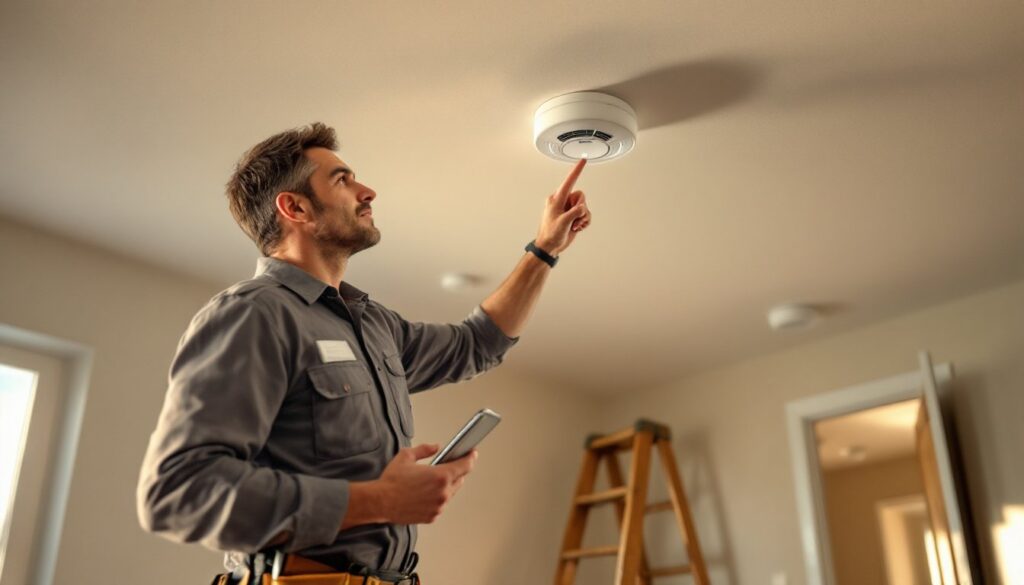
Every smoke detector has a test button, usually a prominent circle or rectangle on the face. Press and hold it for 3-5 seconds. You should hear a loud, piercing alarm within seconds. If the sound is weak, muffled, or delayed, the unit needs attention, either a battery change or full replacement.
For interconnected systems (where one alarm triggers all others), test each unit individually to verify the mesh network is functioning. If pressing one detector doesn’t trigger the rest, there’s a wiring issue or a failed transmitter in wireless models.
While you’re at the detector, vacuum around the grille openings with a soft brush attachment. Dust and cobwebs block airflow to sensors, reducing sensitivity. Don’t use compressed air, it can drive particles deeper into the chamber.
Safety note: If you have a monitored system connected to a security panel, put it in test mode first or notify your monitoring service. Otherwise, you’ll dispatch the fire department.
For smart smoke detectors, verify that mobile alerts are working. Many smart home systems allow remote testing and will notify you if a unit goes offline. Test the app notification at least quarterly to confirm connectivity.
Mark your calendar with the installation date or replacement date for each detector. Smoke alarms have a ten-year lifespan from manufacture date (stamped on the back). If a unit is approaching or past that mark, monthly testing won’t save it, the sensor itself is degraded.
Annual Fire Alarm System Maintenance Checklist
Once a year, spring or fall works well, perform deeper maintenance that goes beyond the monthly test button routine.
Replace all batteries in battery-powered and hardwired backup units, even if they haven’t chirped. Use the same battery type specified on the detector label: typically 9V alkaline or AA lithium. Lithium batteries last longer and perform better in temperature extremes, but cost more upfront. Never use rechargeable batteries, they don’t deliver consistent voltage as they discharge.
For hardwired detectors, check that the green LED indicator (if present) is lit, confirming AC power. If it’s off, the circuit breaker may have tripped or a wire connection has loosened. Turn off power at the breaker before opening the detector mount to inspect wiring. Look for corrosion on wire nuts or loose connections at the pigtail.
Remove each detector from its mounting bracket and wipe down the exterior and sensor chamber with a dry microfiber cloth. Don’t use water or cleaning products, moisture can damage electronics. If you see significant residue inside the chamber, the unit is likely near end-of-life.
Battery Replacement and Power Source Inspection
Battery compartments are usually accessed by twisting the detector body counterclockwise or sliding a latch. Some hardwired models have a compartment that opens without removing the entire unit from the ceiling mount. Keep the old battery in hand while installing the new one, this prevents accidentally leaving a unit without power.
After battery replacement, press the test button again and verify a strong alarm. If the unit chirps intermittently even with a fresh battery, the sensor has likely failed and the detector needs full replacement.
Inspect the manufacture date on the back of each detector. NFPA 72 and most home safety guidelines recommend replacing smoke alarms every ten years regardless of apparent function. Write the installation date on the mounting bracket with a permanent marker for future reference.
For combination smoke/CO detectors, note that carbon monoxide sensors typically have a shorter lifespan, around seven years. These units will display an end-of-life warning when the CO sensor expires, even if the smoke detection still works. Replace the entire unit when this happens.
If you have a central fire alarm panel (common in larger homes or those with monitored security systems), consult the panel’s manual for annual maintenance procedures. These often include backup battery replacement in the panel itself, not just the individual detectors.
Common Fire Alarm Problems and How to Fix Them
False alarms from cooking or shower steam: Detectors within 20 feet of kitchens or bathrooms are prone to nuisance alarms. The fix is relocating the unit farther away (at least 10 feet from cooking appliances, per NFPA 72) or switching to a photoelectric detector, which is less sensitive to steam than ionization models. Never disable a detector to stop false alarms, move it instead.
Intermittent chirping: This usually signals a low battery, but if it persists after replacement, the backup battery compartment may have a poor connection. Remove the battery, clean the contacts with a pencil eraser, and reseat it. If chirping continues, the detector’s internal capacitor may be failing, replace the unit.
Alarm sounds randomly for a few seconds, then stops: This is often environmental. Temperature swings, high humidity, or insects inside the chamber can trigger brief alarms. If it happens repeatedly, remove and clean the detector. If it recurs, replace the unit, intermittent failures are a sign of sensor degradation.
Interconnected alarms won’t sync: For hardwired interconnect systems, the problem is usually a loose or corroded interconnect wire (typically orange or yellow). Turn off power at the breaker, open each detector, and check that the interconnect wire is firmly attached and wire nuts are tight. For wireless systems, consult the manual, you may need to re-pair units to the base station.
Hardwired detector won’t stop alarming: First, ensure there’s no actual smoke or CO. If it’s a false alarm, try pressing and holding the test button for 10-15 seconds to reset the unit. If that fails, shut off power at the breaker for 30 seconds, then restore power. Persistent alarms on a hardwired unit often mean sensor failure, replace it.
Alarm doesn’t sound during test: If a fresh battery doesn’t fix it, the unit is dead. Smoke detectors can’t be repaired, replacement is the only option. Dating the units when you install them prevents surprises down the line.
When to Call a Professional for Fire Alarm Service
DIY maintenance covers most residential fire alarm needs, but certain situations require a licensed electrician or fire alarm technician.
Hardwired system installation or major reconfiguration: Adding detectors to meet code during a remodel, or rewiring an interconnected system, involves running new circuits and ensuring proper interconnect wiring. This often requires a permit and inspection. While a confident DIYer can handle the physical work, an electrician ensures compliance with NEC Article 760 (fire alarm systems) and local amendments.
Monitored systems connected to security panels: These integrate with central station monitoring and may include features like automatic fire department dispatch. Troubleshooting communication faults, replacing control boards, or programming new zones should be handled by the security company or a certified technician. Improper work can void monitoring agreements.
Recurring false alarms even though cleaning and relocation: A professional can test detectors with calibrated smoke and CO sources to determine if sensors are functioning within spec. They can also identify electrical issues, like voltage drops or ground faults, that cause phantom alarms.
Commercial-grade systems in larger homes: Some high-end or older homes have addressable fire alarm systems with a central panel, pull stations, and horn/strobe notification devices. These are more complex than residential point detectors and require certified technicians for annual inspection and maintenance. Many jurisdictions mandate annual professional inspection for addressable systems, even in residential occupancies.
Post-fire inspection: Even if detectors appeared to function during a fire, smoke and heat exposure can damage sensors. Have a professional inspect and replace any detectors in affected areas, and verify that interconnected alarms weren’t compromised.
Cost for professional service varies widely by region and scope. Expect $100-$200 for a basic inspection and testing visit, more if detectors need replacement or wiring repairs. Factor this into your annual home maintenance budget if you have a complex system.
Safety first: If you’re uncomfortable working on ladders, dealing with electrical connections, or troubleshooting a system you don’t understand, calling a pro isn’t a cop-out, it’s the smart move. A working fire alarm system is too important to leave half-fixed.