Heat pump water heaters (HPWHs) are efficiency champs, pulling heat from surrounding air to warm water instead of generating it directly. They can slash energy costs by up to 60% compared to standard electric units. But here’s the catch: that efficiency depends on regular maintenance. Unlike conventional tanks that mostly just sit there, HPWHs have compressors, evaporator coils, fans, and filters that need attention. Skip the upkeep, and you’ll watch efficiency drop, operating costs climb, and lifespan shrink. This guide walks through the essential maintenance tasks, monthly checks to annual service, that keep a heat pump water heater running at peak performance for 10–15 years or more.
Table of Contents
ToggleKey Takeaways
- Heat pump water heater maintenance prevents efficiency loss of 10–15% and extends lifespan from 7–8 years to 12–15 years, saving thousands on early replacement.
- Monthly air filter cleaning and condensate drain inspections are straightforward DIY tasks that take under an hour and prevent the most common HPWH failures.
- Annual professional maintenance (or DIY deep checks) addresses evaporator coils, T&P valves, tank flushing, and refrigerant lines—required by most manufacturers to honor warranty coverage.
- Refrigerant work, electrical troubleshooting beyond basic inspection, and compressor replacement must be handled by EPA-certified HVAC technicians to ensure safety and system integrity.
- Common issues like inadequate hot water, continuous running, or water pooling are often resolved through filter cleaning, drain clearing, and mode adjustment before calling a professional.
Why Regular Maintenance Matters for Heat Pump Water Heaters
Heat pump water heaters work harder than standard tanks. They circulate air across evaporator coils, compress refrigerant, and transfer heat, all while generating condensate and pulling in dust. When filters clog, drains block, or coils get dirty, the system struggles to extract heat efficiently. The compressor runs longer, electricity use climbs, and internal components wear faster.
Regular maintenance addresses three critical areas: airflow, drainage, and refrigerant cycle integrity. A clogged air filter can reduce efficiency by 10–15% within months. A blocked condensate drain can trigger shutdowns or cause water damage. Neglected coils force the compressor to work overtime, shortening its lifespan and potentially voiding warranties, most manufacturers require proof of annual service to honor coverage.
Beyond efficiency, there’s the lifespan factor. A well-maintained HPWH can last 12–15 years. One that’s ignored might fail at 7–8 years, often requiring a $1,200–$2,500 replacement (price varies widely by region and model). Spending 30 minutes every few months on basic upkeep beats an early replacement bill.
Finally, HPWHs installed in conditioned spaces (basements, utility rooms) pull heat from the surrounding air, which can cool the room 2–4°F. If the system’s running inefficiently due to poor maintenance, it extracts more heat to meet demand, making the space uncomfortably cold in winter. Keeping it tuned reduces this side effect.
Essential Monthly and Quarterly Maintenance Tasks
The good news: most routine HPWH maintenance is straightforward and takes under an hour. These tasks keep airflow and drainage in check, preventing the most common failure points.
Cleaning the Air Filter
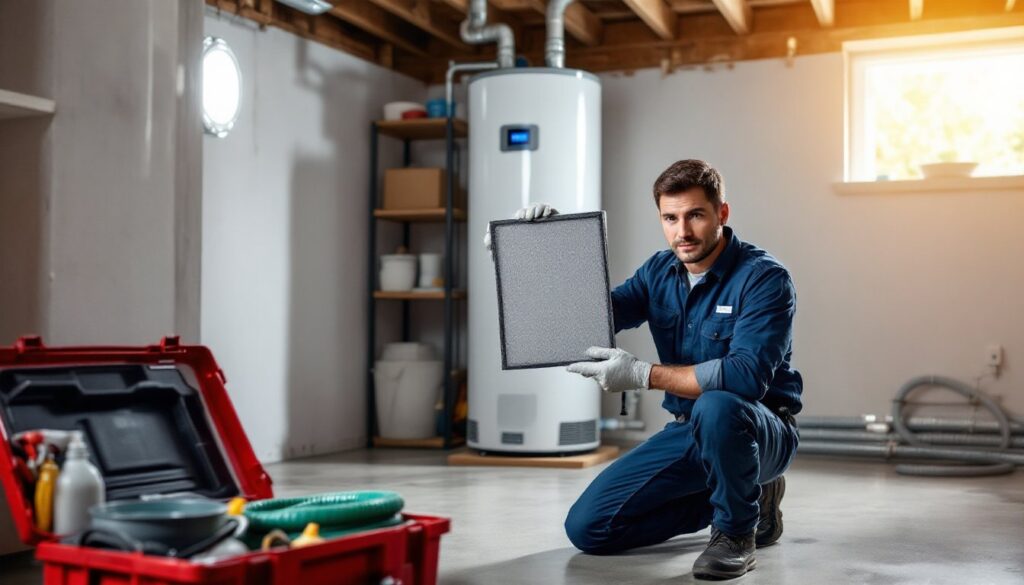
The air filter protects the evaporator coil from dust, lint, and pet hair. Most HPWHs use a washable foam or mesh filter behind a front or side access panel. Check it monthly in dusty environments or homes with pets: quarterly otherwise.
Steps:
- Turn off power at the breaker. HPWHs pull 240V: don’t skip this.
- Remove the filter access panel (usually secured with screws or clips).
- Slide out the filter. If it’s visibly caked with dust, it’s overdue.
- Rinse under warm tap water until the runoff is clear. For stubborn buildup, use mild dish soap and a soft brush.
- Let the filter air-dry completely before reinstalling, wet filters can mold or restrict airflow even worse than dirty ones.
- Reinstall, replace the panel, and restore power.
Some units have a filter indicator light: don’t rely on it exclusively. Visual inspection catches problems earlier. A clean filter ensures the fan pulls adequate airflow across the coils, critical for heat transfer. Homeowners who skip this step often efficiency drop noticeably within the first year.
Inspecting the Condensate Drain
As the HPWH pulls heat from air, it also pulls moisture, sometimes a gallon or more per day. That water exits through a condensate drain line, usually a ¾-inch PVC pipe running to a floor drain, pump, or outdoor discharge.
Check the drain monthly, especially in humid climates or basements:
- Locate the drain pan (typically beneath the unit) and drain line.
- Look for standing water in the pan. Any pooling means the line is partially or fully blocked.
- Flush the line with a mix of 1 cup white vinegar and 1 cup warm water to dissolve algae or mineral buildup. Pour it into the drain opening or access port.
- If water backs up, use a wet/dry vac on the line’s outlet end to pull the clog free. A length of CPVC or PEX pipe can also be used as a manual snake.
- Inspect the drain pan for cracks or rust. Replace if compromised, water damage from a failed pan isn’t covered by most homeowner’s insurance.
If the unit has a condensate pump (common in installations without gravity drainage), listen for the pump cycling during operation. A silent pump or continuous running signals a problem, either a failed pump or a clogged discharge line. Test the pump by pouring water into the reservoir: it should activate and drain within seconds.
Annual Maintenance Checklist for Peak Performance
Once a year, go deeper. These tasks address components that degrade slowly but impact long-term performance and safety.
Annual checklist:
-
Inspect evaporator coils: Remove the access panel and visually check the coils for dust, lint, or corrosion. If dirty, use a soft brush or vacuum with a brush attachment. Avoid compressed air, it can bend delicate fins. If coils are heavily fouled or corroded, call a tech: coil cleaning requires refrigerant handling in some cases.
-
Check the temperature and pressure relief (T&P) valve: Located on the tank’s side or top, this valve prevents dangerous pressure buildup. Lift the test lever briefly, water should discharge through the overflow pipe. If it doesn’t release or drips continuously after testing, replace it. Warning: Stand clear of the discharge, water can be scalding.
-
Flush the tank: Sediment settles even in HPWHs. Attach a garden hose to the drain valve, run it to a floor drain or outdoors, open the valve, and flush 2–3 gallons. This removes mineral buildup that insulates the heat exchanger and reduces efficiency.
-
Inspect electrical connections: With power off, open the service panel and look for loose terminals, burned wires, or corrosion. Tighten any loose connections with a screwdriver. If you see charring or smell burning, call an electrician, electrical faults can start fires.
-
Test the defrost cycle (if equipped): Some HPWHs in cold climates have a defrost mode to prevent coil icing. Consult the owner’s manual for test procedures, most involve setting the unit to a specific mode and monitoring for proper fan and compressor cycling.
-
Check refrigerant lines: Look for oil stains, frost buildup, or hissing near refrigerant line connections. These indicate leaks. Refrigerant work requires an EPA 608-certified tech, don’t attempt DIY repairs.
-
Verify clearances: HPWHs need 700 cubic feet of air space minimum (some models require 1,000). Ensure nothing’s blocking airflow within 12–18 inches of the intake and exhaust. Blocked airflow forces the unit into electric resistance mode, killing efficiency.
Many repair issues traced to poor upkeep can be avoided with this annual rundown. Budget 90–120 minutes, or hire a licensed plumber or HVAC tech for $150–$250 (regional variation applies).
Troubleshooting Common Heat Pump Water Heater Issues
Even with diligent maintenance, HPWHs can throw curveballs. Here’s how to diagnose and address the most frequent problems.
Inadequate hot water:
- Check the mode setting. Many units have Efficiency, Hybrid, Electric, and Vacation modes. If someone switched it to Vacation or Efficiency during high demand, recovery will be slow. Set to Hybrid for balanced performance.
- Inspect the upper and lower heating elements (if accessible). Use a multimeter to test for continuity. A failed element requires replacement, straightforward for someone comfortable with electrical work, but hiring a pro is safer if you’re not.
- Verify the thermostat setting. HPWH thermostats are often set to 120°F by default. Raising to 130°F (max safe residential temp per ANSI standards) increases capacity but also scalding risk if small children are present.
Error codes or flashing lights:
- Consult the owner’s manual, error codes vary by manufacturer. Common codes indicate high-pressure shutoff, sensor faults, or defrost cycle issues.
- Reset the unit by flipping the breaker off for 30 seconds. If the code returns immediately, the issue is persistent and likely needs a tech.
Excessive noise:
- Rattling or vibrating: Check that the unit sits level and that mounting brackets (if wall-mounted) are secure. Loose fan blades or debris in the fan housing can also rattle.
- Hissing or gurgling: Normal during refrigerant circulation, but loud hissing can signal a refrigerant leak. If accompanied by reduced performance, call a tech.
- Popping or rumbling from the tank: Sediment buildup. Flush the tank per the annual checklist.
Unit running constantly:
- Verify the air filter isn’t clogged and the condensate drain is clear. Both force longer run times.
- Check for undersized capacity. A 50-gallon HPWH is rated for 3–4 people. A household of 6 will overwhelm it. Consider adding a timer to high-draw appliances (dishwasher, washing machine) to stagger demand.
- In winter, HPWHs in unheated spaces may struggle to extract heat if ambient temp drops below 40°F. Some units automatically switch to electric resistance mode, which uses more energy.
Water on the floor:
- Inspect the condensate drain and pan first, 90% of HPWH leaks are condensate-related, not tank failure.
- Check the T&P valve and inlet/outlet connections for drips. Tighten fittings if needed.
- If water is coming from the tank body itself, the tank has corroded through. That’s a replacement job.
When to Call a Professional vs. DIY Maintenance
Most HPWH maintenance is DIY-friendly if you’re comfortable with basic electrical safety (flipping breakers, checking connections) and plumbing (flushing drains, replacing valves). Here’s where to draw the line.
DIY-safe tasks:
- Cleaning or replacing air filters
- Flushing condensate drains
- Testing and replacing the T&P valve (widely available for $15–$30)
- Flushing the tank to remove sediment
- Inspecting coils and clearances
- Resetting error codes and adjusting mode settings
Call a licensed professional for:
- Refrigerant work: Handling refrigerants requires EPA 608 certification. Leaks, recharging, or compressor replacement must be done by a qualified HVAC tech.
- Electrical troubleshooting beyond basic inspection: If you’re seeing repeated breaker trips, error codes after resets, or burned wiring, bring in a licensed electrician. HPWHs pull significant amperage (typically 30A circuits), and mistakes can cause fires or electrocution.
- Compressor or control board replacement: These are expensive parts ($400–$800 just for the component), and installation requires specialized knowledge. A misdiagnosis can cost more than the repair.
- Persistent performance issues: If hot water recovery stays slow after you’ve checked filters, drains, and settings, the problem is likely internal, failed sensors, faulty thermostats, or refrigerant loss.
- Tank replacement: If the tank has corroded or the heat pump system has catastrophically failed on an older unit (8+ years), replacement often makes more economic sense than repair. A pro can assess whether repair costs justify the remaining lifespan.
Warranty considerations: Many HPWH warranties require annual professional service to remain valid. Check your documentation. If service is required, expect to pay $150–$250 for a qualified tech to run through the checklist, test components, and provide documentation. That receipt can save thousands if a major component fails under warranty.
Safety note: Always wear safety glasses when working around the unit (sediment and water can spray during flushing), and gloves when handling the T&P valve or accessing the tank. Turn off power at the breaker before opening any electrical panels. If you’re uncertain about any task, hiring a pro beats a hospital visit or an insurance claim.
For homeowners interested in integrating smart home technology for monitoring water heater performance, several HPWHs now offer Wi-Fi connectivity and app-based diagnostics, useful for catching issues early, but they don’t replace hands-on maintenance.